
 EN
 VI
 IT
 ES
 TH
 PT
 LV
 NL
 RU
 FR
 DE
 AR
 UZ



China Car Export: Common Challenges for International Buyers
In 2023, China overtook Japan to become the world's largest automobile exporter — a position it has held ever since. Chinese automakers shipped roughly 5.8 million vehicles overseas in 2024, and the pace has only accelerated, powered by a wave of electric vehicles that now dominate global EV trade. For dealers, fleet operators, and distributors across the Middle East, Africa, Southeast Asia, Latin America, and Europe, sourcing vehicles from China can deliver margins that are simply impossible through traditional supply chains. Yet behind the headline numbers sits a practical reality: buying cars from China involves complications that most first-time importers underestimate. Below are the most common challenges international buyers face — and how seasoned importers navigate them.
1. Knowing Who You're Really Dealing With
The single biggest risk in China car export is not the car — it's the counterparty. The export ecosystem spans automakers, licensed export companies, trading houses and, inevitably, fraudsters. Fake business licenses, staged photoshoots in borrowed showrooms, and business email compromise (BEC) schemes — where a hacker redirects your deposit to a fraudulent account — are well documented. Buyers should verify a company's business license through China's National Enterprise Credit Information Publicity System, confirm its used-car export qualification, demand live video inspections from the actual storage yard, and commission independent third-party inspections before releasing any balance. Any supplier who resists basic verification is telling you something important.
2. Compliance and Homologation
A vehicle fully legal in China is not automatically legal in your market. Import rules differ on drive side (RHD conversions for Southern Africa, Southeast Asia and Oceania), emissions (Euro 6 for much of Africa and the CIS; GCC specifications for the Gulf), lighting and labeling standards, speedometer units — even dashboard language. Many markets also impose age limits on used vehicle imports, typically five to ten years, while some countries restrict EV imports to new vehicles only. Homologation costs and timelines must be calculated before you commit, not after the vessel sails. The fix: lock the exact configuration, VIN-level if possible, against your country's conformity requirements in the proforma invoice.
3. Documentation and Customs Clearance
International vehicle trade runs on paper, and one missing document can strand a consignment at the destination port while demurrage fees accumulate daily. The standard package includes the bill of lading, commercial invoice, packing list, certificate of origin and export declaration. Electric vehicles add another layer: battery UN38.3 test summaries, MSDS (material safety data sheets), state-of-health reports and, depending on the destination, a certificate of conformity (COC). Reputable exporters treat documentation as a standardized deliverable, with digital copies dispatched before the vessel arrives.
4. Logistics, Freight Volatility and Transit Risk
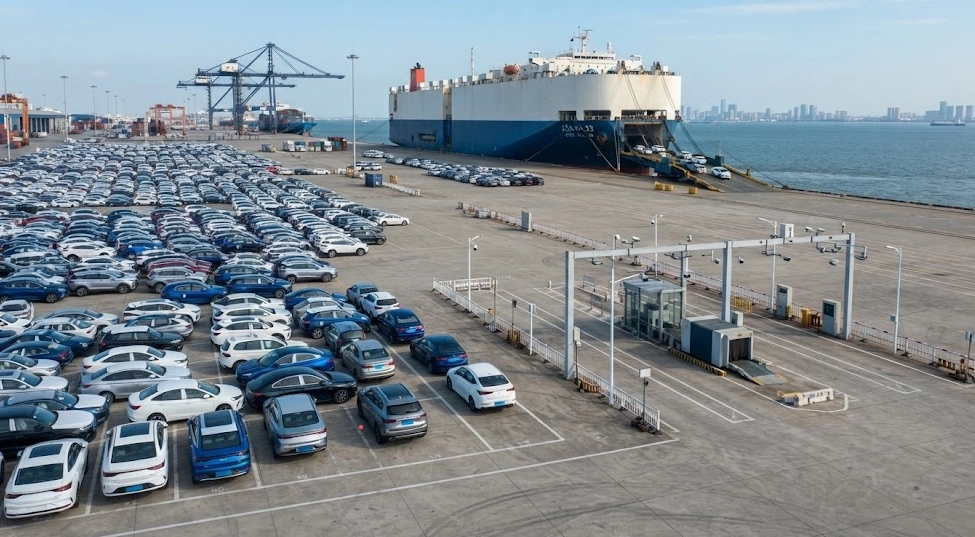
RoRo (roll-on/roll-off) shipping is the default for wheeled cargo, but container loading — sometimes two or three vehicles per 40-foot high-cube — offers better protection for high-value EVs. Freight rates remain volatile: Red Sea disruptions that rerouted Asia–Europe sailings around the Cape of Good Hope lengthened transit times and lifted costs through 2024–2025, and capacity tightens sharply ahead of Chinese New Year. EV shipments also carry specific requirements, including state-of-charge limits (generally 30–50 percent) under maritime battery safety rules. Marine cargo insurance on ICC (A) terms is non-negotiable for any serious buyer.
5. Payment Security and Currency Exposure
The standard China trade term is T/T in advance — which works fine with a verified partner and is dangerous without one. Prudent buyers stage payments: a deposit against a signed contract, an inspection milestone, and the balance only after the bill of lading is issued. Escrow services, platform-guaranteed transactions and irrevocable letters of credit each have their place depending on order size. On larger contracts, currency exposure matters too; RMB-denominated pricing removes the dollar middle step but transfers FX risk to the buyer.
6. After-Sales Support and Parts Availability
The sticker price is only half the equation. Chinese EVs often ship with Mandarin-language infotainment, region-locked telematics and diagnostic software that many overseas workshops cannot operate. Parts availability — filters, brake components, battery modules — varies enormously by brand. Smart importers negotiate a starter parts package, diagnostic tools and English-language firmware commitments into the first purchase order, and increasingly choose suppliers that can support multiple brands so a single parts channel serves the entire fleet.
The Industry Is Professionalizing — Choose Partners Accordingly
The good news is that the industry itself is maturing. China's used-car export pilot program, expanded nationwide in 2024, tightened licensing requirements and pushed gray-market "zero-kilometer used cars" toward the margins, while digital verification tools have made due diligence easier than ever. Established one-stop export houses now bundle what used to require five separate vendors.
Moluoni helps international buyers manage several key stages of the China car export process through one export service. The company sources new and used vehicles across sedans, SUVs, MPVs, pickups, gasoline models, hybrids, and new energy vehicles, while also providing vehicle inspection and specification confirmation before shipment. For used cars, buyers can receive vehicle condition information and inspection details to reduce uncertainty when purchasing remotely.
Moluoni also supports export documentation, customs procedures, and international vehicle transportation. Depending on the destination and shipment requirements, vehicles can be arranged through Ro-Ro or container shipping, with loading and logistics coordination included in the process. By connecting sourcing, inspection, documentation, and shipping, Moluoni helps international buyers reduce the need to coordinate multiple suppliers during a China car export transaction.
The lesson of the past three years is straightforward: the opportunity in China's car export boom is structural, but the difference between a profitable container and an expensive lesson is the professionalism of the partner on the China side.